
Fayette County Court Records After Arrest
After a Fayette County arrest, the first file is usually a jail or law-enforcement record. It reflects intake, custody, and the allegation used to book the person at the Fayette County Jail operated by the Fayette County Sheriff's Office, where the official county page identifies Sheriff Ronnie Stevens. The formal court record is different. It begins in the Fourth Judicial Circuit, Fayette County Circuit Court, when a criminal case is filed and the Clerk keeps the official record. The Fayette County Circuit Clerk describes that office as the administrative and clerical arm of the court, the official recorder for court filings, and the custodian of complete court records.
The Fayette County State's Attorney is the local prosecutor. That office reviews police reports, decides what charges to file or pursue, and appears in pretrial release or detention proceedings. A jail booking charge can be a starting point, but the court docket is the better source for the charge that was filed, amended, reduced, dismissed, or resolved. For custody and booking details, use the Fayette County jail inmate records path. For booking photos, use the Fayette County jail mugshots record path. Court records after a jail arrest are about the case that follows.
The Circuit Clerk page also gives the public access rule for Fayette County case files. Public case files and documents may be viewed in the Clerk's office during business hours, with exceptions for juvenile, adoption, impounded, and sealed cases. That same page points users to Judici for public case information. Official copies and certified records still come from the Clerk, not from a search vendor.
Find Fayette County Court Records
Fayette County court records after an arrest are searched through the Circuit Clerk's public access route and the county's Judici endpoint. The inspected Judici Fayette County case search triggered hCaptcha, so a user may need to complete human verification before seeing the case search fields. That access note is important. A blocked or timed-out online search does not mean no case exists. It may mean the search page requires a live browser session, a completed hCaptcha, or in-person Clerk access.
- Confirm the custody side first through VINELink or the Fayette County Jail if the arrest was recent.
- Open the Circuit Clerk's court-search route and complete any Judici hCaptcha prompt.
- Search by defendant name or case number if the fields are available after verification.
- Open the case docket and compare the filed charges with any arrest or booking charge.
- Check each charge for status, court dates, release orders, disposition, and sentence entries.
- Contact the Circuit Clerk for older, sealed, impounded, or document-level requests.
The Circuit Clerk's office is at Fayette County Courthouse, 221 S 7th St, Room 112, Vandalia, IL 62471. The phone number is 618-283-5009, and public hours are Monday through Friday, 8 am to 4 pm, excluding legal holidays. The office also has a Public Access Computer for case-related use by the public. That is the practical fallback when Judici is unavailable or when a document must be inspected rather than just searched.
The source image below comes from the official Circuit Clerk page and shows the local office that maintains Fayette County court records.
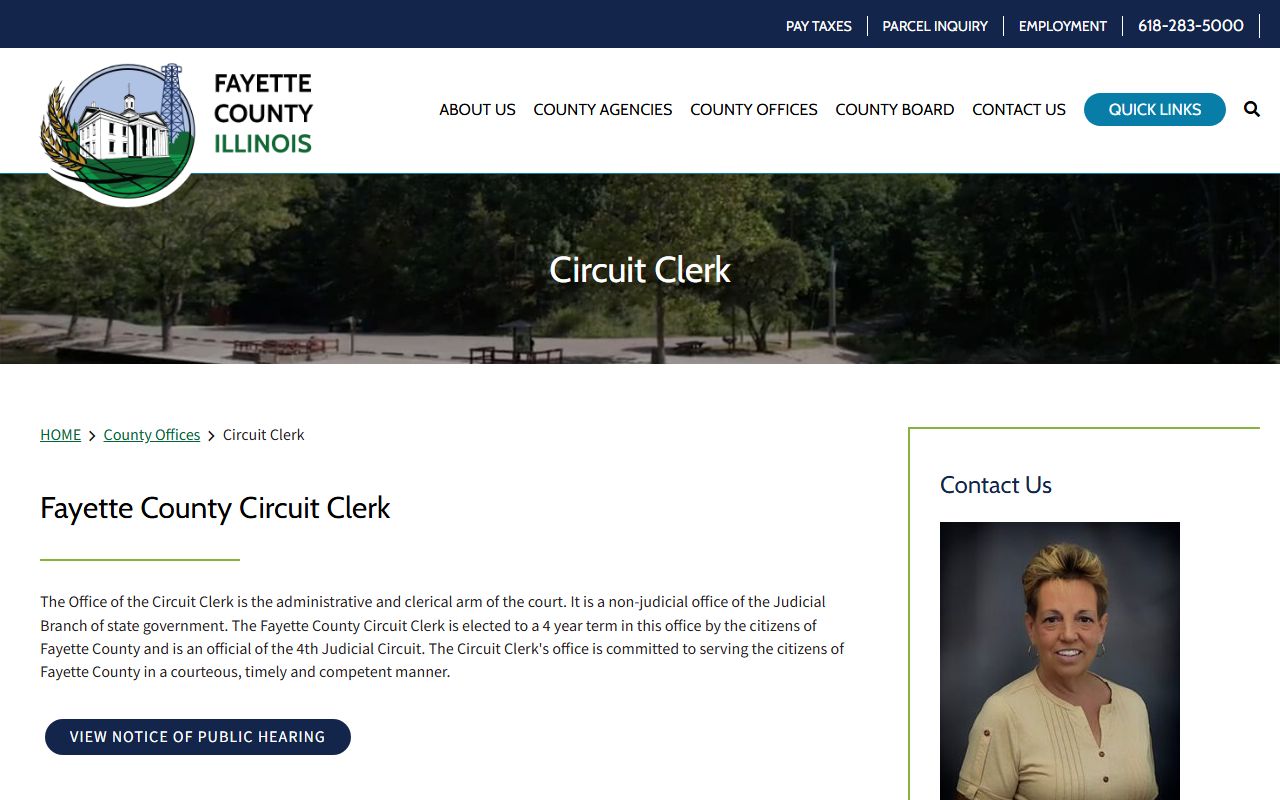
Use the Clerk's office for official case-file access, copy requests, and questions about public file inspection.
Fayette County Arrest Case Search
Judici is the public case-search vendor linked for Fayette County, but the research pass could not inspect the full case form because the endpoint produced a human-verification screen. The known fields are therefore limited. That limitation should shape expectations: the online case search can help locate docket-level records, but the Circuit Clerk remains the official office for documents, certified copies, public computer access, and case-file review.
| Search Element | What It Means | Access Note |
|---|---|---|
| Human verification | hCaptcha may appear before search fields load. | Complete it in a live browser. |
| Court selection | The inspected URL includes court=IL026015J for Fayette County. | Use the county-specific court endpoint. |
| Name or case number | Judici commonly supports case lookup by party or case number. | Exact visible fields were not inspectable. |
| Login or subscriber links | Some features may be limited or premium. | Public docket access can differ from document access. |
The source image below shows the Judici access point located for Fayette County court records after an arrest.
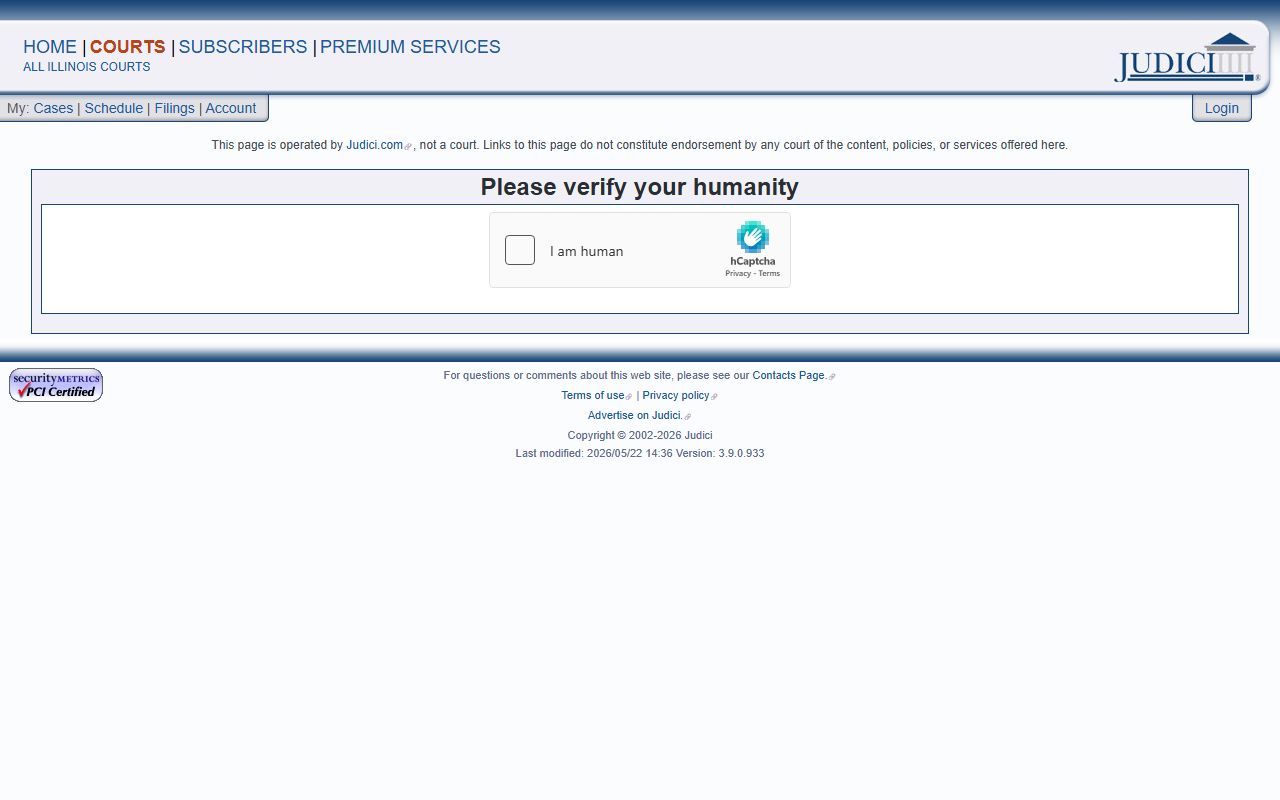
If online access fails, use the Clerk's public access computer or ask the Clerk how to request the specific case file.
Fayette County Arrest Charges Filed
The State's Attorney's review is the point where arrest facts become formal court charges. Illinois counties use a State's Attorney, not a District Attorney. In Fayette County, the State's Attorney's Office handles felony, misdemeanor, traffic, juvenile, and victim/witness duties. Brenda Mathis is listed as State's Attorney in the research source. The office is at 221 S 7th St, Room 201, Vandalia, IL 62471, with phone 618-283-5040 and hours Monday through Friday, 8 am to 4 pm.
Three kinds of charging documents may appear in criminal cases. The exact path depends on the charge, the stage of review, and whether the matter goes to a grand jury. A complaint can start a case. An information is a formal charge filed by the prosecutor. An indictment is a grand-jury charge, often used for serious felony matters.
| Document | Who Uses It | What It Does |
|---|---|---|
| Complaint | Law enforcement or prosecutor | States the alleged offense and can begin the criminal case. |
| Information | State's Attorney | Formally files prosecutor-approved charges in court. |
| Indictment | Grand jury, with prosecutor involvement | Charges an offense after grand-jury action, often in serious cases. |
The source image below comes from the official State's Attorney page and identifies the office that handles criminal charging for Fayette County.
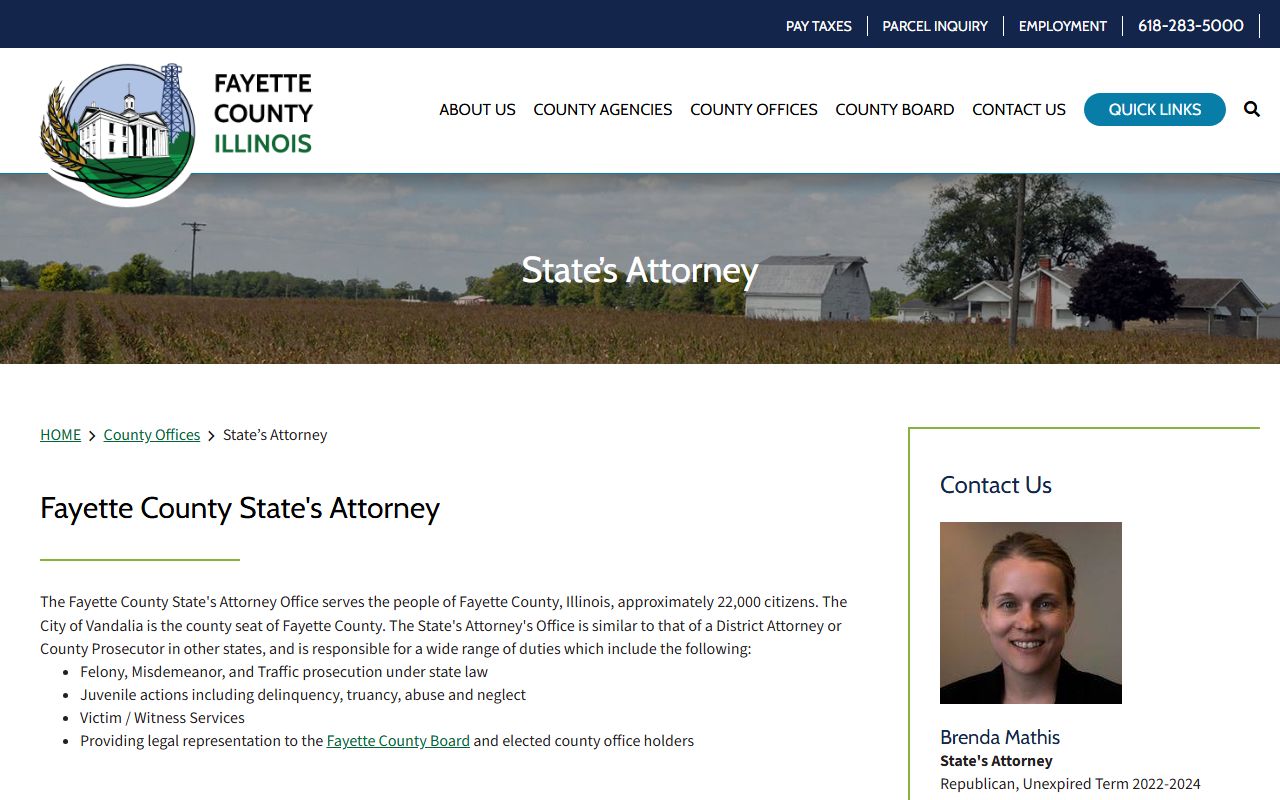
Victims and witnesses may also receive information from the prosecutor's office, while release or transfer notices may come through VINE registration.
Fayette County Charge Status
Charge status is the reason court records after a jail arrest should be checked more than once. A booking charge may say one thing at intake. The prosecutor may file a different count, add a count, reduce a felony to a misdemeanor, dismiss a count, or stop pursuing a count. The docket is the place to see the formal version because each charge can have its own status and disposition.
| Status | Plain Meaning | Why It Matters |
|---|---|---|
| Pending | The charge is active and not yet resolved. | Future court dates or release terms may apply. |
| Amended | The charge was changed by court or prosecutor filing. | The arrest charge and court charge may no longer match. |
| Reduced | The charge level or offense was lowered. | Felony and misdemeanor consequences differ. |
| Dismissed | The charge ended without a conviction on that count. | Sealing or expungement questions may follow. |
| Nolle prosequi | The prosecutor declined to continue that charge. | The docket may abbreviate it as nolle. |
| Disposition | The final result for a charge or case. | It may show conviction, dismissal, sentence, or other outcome. |
Pretrial Release After Fayette Arrest
Illinois changed the old cash-bail model. Under the Pretrial Fairness Act framework, cash bail ended for new Illinois criminal cases effective September 18, 2023. Fayette County court records may still use the word bond because older terms remain common, and the Fayette County jail rules still include bond-payment instructions. The legal decision, however, is now framed as pretrial release, conditions, or detention. A judge decides whether the person is released with conditions or detained after the State seeks detention in a qualifying case.
The Fayette County jail PDF says a $40 processing fee is added to the bond amount for persons processed through the jail. It also lists cash at the jail and credit or debit card payment through CourtMoney.com after calling the jail for the required information, with an 8 percent card charge. Those local payment facts should be read with care. State law controls release and detention, while the jail instructions describe payment processing when a court-ordered monetary transaction still exists.
- Pretrial release
- Release before trial with court orders to return and follow set conditions.
- Detention hearing
- A court hearing on whether a defendant should remain in jail before trial.
- Hold or detainer
- A separate custody reason, such as another warrant, state hold, federal hold, or ICE matter.
- Personal recognizance
- Release based on a promise to appear and obey court conditions.
For current custody status, call the Fayette County Jail at 618-283-2141 and use the county's official inmate information PDF for local jail instructions. For filed release orders, hearing dates, and docket entries, use Judici or the Circuit Clerk. For detention motions or charging decisions, the State's Attorney's filings and court record are the source.
Fayette County Warrants and Arrest Records
No official Fayette County online active-warrant search was located in the official sheriff sources. The local jail rules give a clear access rule: the Sheriff's Office does not provide outstanding warrant information by phone, and all inquiries must be made in person at the jail lobby. That means the main sheriff or jail number is useful for general contact, but it should not be treated as a warrant-confirmation line.
A warrant can still show up in court records after a jail arrest. A bench warrant may appear after a missed court date. An arrest warrant may lead to booking at the Fayette County Jail. An out-of-county or federal hold may keep a person in custody even if the local case is otherwise resolved. For a filed criminal case, Judici or the Circuit Clerk may show warrant issue, return, recall, or quash entries. For safety and legal risk, a person with a possible warrant should contact counsel or the court rather than relying on any public web search alone.
Local warrant rule: Fayette County's jail information says outstanding-warrant inquiries must be made in person at the jail lobby, not by phone.
Charges Versus Convictions
A charge is an accusation. A conviction is a final finding or admission of guilt, usually after a plea or trial. Court records after a jail arrest may show several charges, but not all charges become convictions. Some are amended, some are dismissed, and some resolve through a plea to a different count. That is why a docket should be read charge by charge, not just by the case title.
| Record Point | Charge | Conviction |
|---|---|---|
| Stage | Filed accusation in a criminal case. | Final guilty plea, verdict, or similar finding. |
| Proof | Based on charging standards and probable cause. | Requires proof or admission sufficient for guilt. |
| Can change? | Yes. It can be amended, reduced, or dismissed. | Changes only through later court action or review. |
| Use caution | Does not prove guilt. | Read sentence and disposition details. |
Sealed and Expunged Fayette Records
Illinois law provides routes to seal or expunge qualifying criminal records. The key statute in the research is 20 ILCS 2630/5.2, the sealing and expungement provision in the Illinois Criminal Identification Act. Eligibility depends on the case result, the type of offense, prior history, timing, and court order. A dismissal does not always make every trace vanish on its own. A person may still need to file the proper petition and obtain an order.
| Issue | Sealed | Expunged |
|---|---|---|
| Public view | Hidden from most public access. | Removed or treated as not publicly existing under the order. |
| Agency access | Some justice agencies may retain limited access. | Access is more limited and controlled by law. |
| Best fit | Some eligible convictions or non-conviction records. | Many eligible arrests, dismissals, acquittals, or qualifying outcomes. |
| Next step | File through the court process. | File through the court process. |
Juvenile, adoption, impounded, sealed, and expunged records are not ordinary public case records. If the Circuit Clerk or Judici does not show a case, it may be restricted rather than absent. A criminal-history background check is also separate from a county court docket and may require a different official process.
Fayette County Court Copy Fees
When a person needs documents instead of a docket view, the Circuit Clerk's fee schedule controls court-file copies. Public inspection is available for public cases at the Clerk's office during posted hours. Copies cost $1 for the first page, $0.50 for each of the next 19 pages, and $0.25 per page after that. The Clerk page says emailed information is slightly higher because of deputy-clerk research, but the exact higher amount was not posted in the research source.
| Copy Item | Posted Amount |
|---|---|
| First page | $1.00 |
| Pages 2 through 20 | $0.50 per page |
| Pages after 20 | $0.25 per page |
| Emailed researched information | Slightly higher, exact amount not posted |
Sheriff's Office FOIA fees are different from court-copy fees. For booking records, reports, or law-enforcement records, the Sheriff's Office FOIA route uses free inspection, the first 50 pages free, 15 cents per page after 50 pages, and 35 cents for a DVD or CD.